
Revised & Updated for 2026
Introduction – Oil Painting Brushes A Beginner’s Essential Guide
Choosing brushes can feel overwhelming when you’re starting out. There are so many brands, shapes and sizes, and every beginner often wonders the same things:
- Which ones do I actually need
- What’s the difference between a flat, a bright, and a filbert
- Should I choose natural or synthetic bristle, and
- Why does every starter kit include a fan brush.
This guide introduces the main types of paintbrushes in a clear, beginner‑friendly way. It answers the most common questions and will help you choose a small, versatile starter set for painting.
Which Brushes do I Actually Need?
The easiest way to answer this is to look at the main brush shapes and what they do, then consider the bristle type, brush size, and the handle length. This will also help address the other questions raised in the introduction.
Brush Shapes
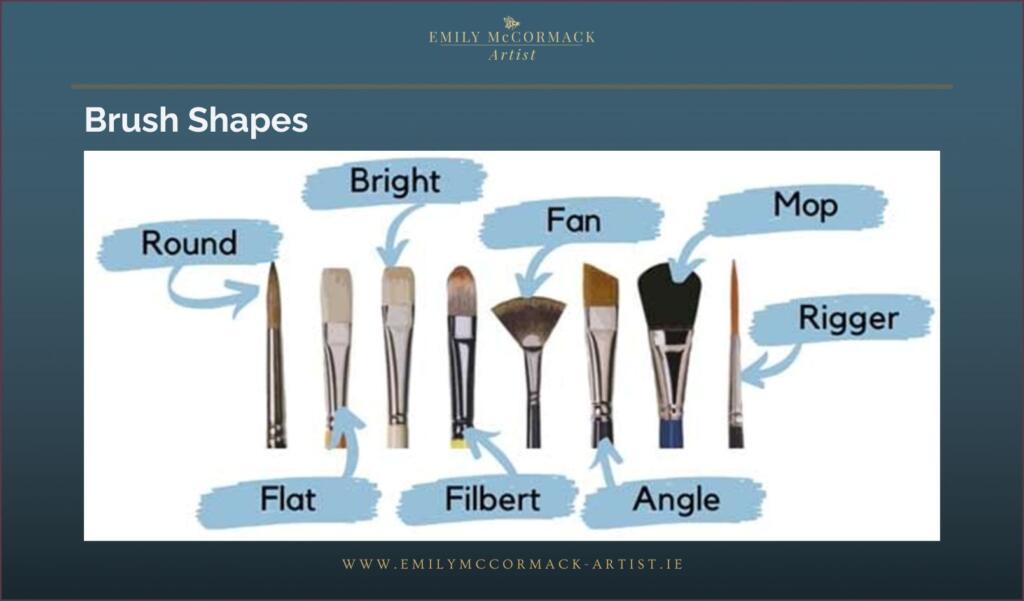
There are many brush shapes available for oil painting, and each one creates a distinct type of mark. The core shapes most artists rely on include the following:
-
Round
Round brushes have a pointed tip and are good for final detail.
A note on round brushes:
While the round brush is included in the beginners painting kit, here at the studio, we use them sparingly at the start of the students painting journey.The reason being, some beginners arrive with habits picked up in casual art classes, where the focus often leans heavily on detail; others have never painted before and naturally hold the brush like a pen because it feels familiar.
In both cases, the round brush tends to pull you into detail too soon.
It also holds more paint than you expect, the point takes practice to control, and the tip can flatten out when you’re trying to make a clean line, all of which can be very frustrating. However, as your confidence grows and you begin to paint from the arm rather than the wrist, the round becomes far more versatile. But in the early stages, broader brushes like flats and filberts help you stay focused on shape, tone and movement instead of getting caught up in detail.
-
Flat
Flat brushes have a wide, flat head with longer bristles than a bright. They come in long or short versions and are great for landscapes, blocking in, cutting around shapes, and using the edge for crisp line work.
-
Bright
A bright is essentially a short‑bristled flat. The shorter hairs make it firmer and more responsive, giving you more control when you want a tighter, more sculptural stroke.
-
Filberts
Filbert brushes have a curved head shaped like a fingernail.
They combine the best of a round and a flat, making it incredibly versatile. They allow an artist to create soft edges, tapered strokes and expressive marks.
These are my “go-to” brushes. For many years I only ever painted with a size 4, 5 or 6 filberts, a palette knife and a roll of kitchen towel. It’s only in recent years that I’ve started using softer brushes, particularly for blending and glazing techniques.
Egberts are long-haired filberts with the same oval tip. The bristles are noticeably longer, often around one‑and‑a‑half to twice the length, giving them a softer, more expressive feel. They’re not essential for beginners.
-
Fan
The famous fan brush, often included in beginner kits, is mainly used for very light blending, creating soft transitions and edges, or gentle texture. It’s usually not strong enough for heavy oil paint or decisive marks.
-
Angle
An angled brush is essentially a flat with a slanted tip. While filberts can wear unevenly and sometimes develop a slight angle, a true angled brush is cut deliberately for that shape. They’re useful for line work, cutting in, and certain floral or decorative techniques, but they’re not commonly used in traditional oil painting. Most oil painters prefer flats, brights and filberts for general work.
-
Mop
Mop brushes are very soft, rounded brushes traditionally used in watercolour for washes and soft transitions. They’re not a core tool for oil painting, but they can be helpful for gentle blending, softening edges or glazing when you want a very light touch. Their recent rise in popularity is mostly due to mixed‑media trends and the availability of new synthetic versions.
-
Rigger
A rigger has very long, thin bristles and is designed for fine, continuous lines: ship rigging, telephone wires, branches, grasses, or signature work.
Other Brushes
Alongside the core brush shapes, you’ll also see a range of speciality brushes on the market. These include:
- daggers and script/liner brushes for long, flowing lines;
- hake brushes for large washes and soft blending;
- various texture tools such as wisp or feathered fans, comb brushes, chopped texture brushes, stipplers, and the deerfoot stippler.
They’re designed for specific effects like grasses, foliage, fur or broad washes. They can be fun to experiment with, but they’re not essential when you’re starting out. Most of these marks can be achieved with a standard flat, filbert or round once you build basic brush control, so think of these as optional extras rather than part of a beginner’s core set;
- house brushes / wide flats are inexpensive wide brushes which are great for toning a canvas or blocking in large areas, but in practice we rarely use them in the studio.
Beginners tend to load them with far too much liquid paint, and when a wide brush hits the edge of the canvas it can flick paint across the walls, floor, clothes, literally everything in range of the splash zone!
Instead, we use a sheet of kitchen roll to apply the first thin layer of paint. It gives far more control, keeps the surface even, and avoids the splash‑zone effect entirely. Once the canvas is toned and the first layer is down, we move on to the regular brushes.
Brush Parts
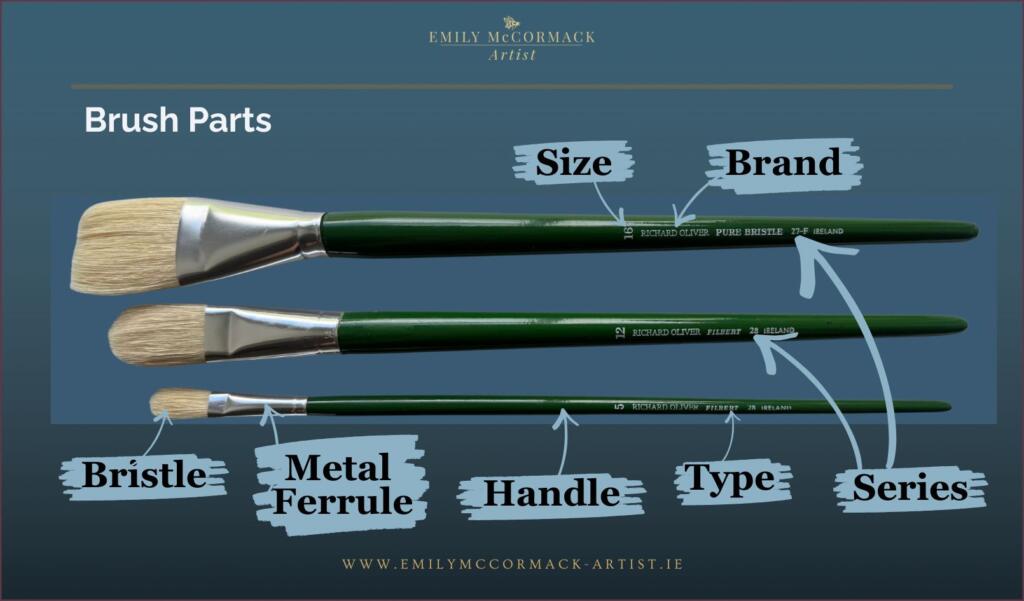
The diagram below outlines the main parts of a paintbrush; the bristles, the metal ferrule (which holds the bristles in place), and the handle. It also shows where the size, brand, type, and series are usually printed along the handle.
Brush Bristle
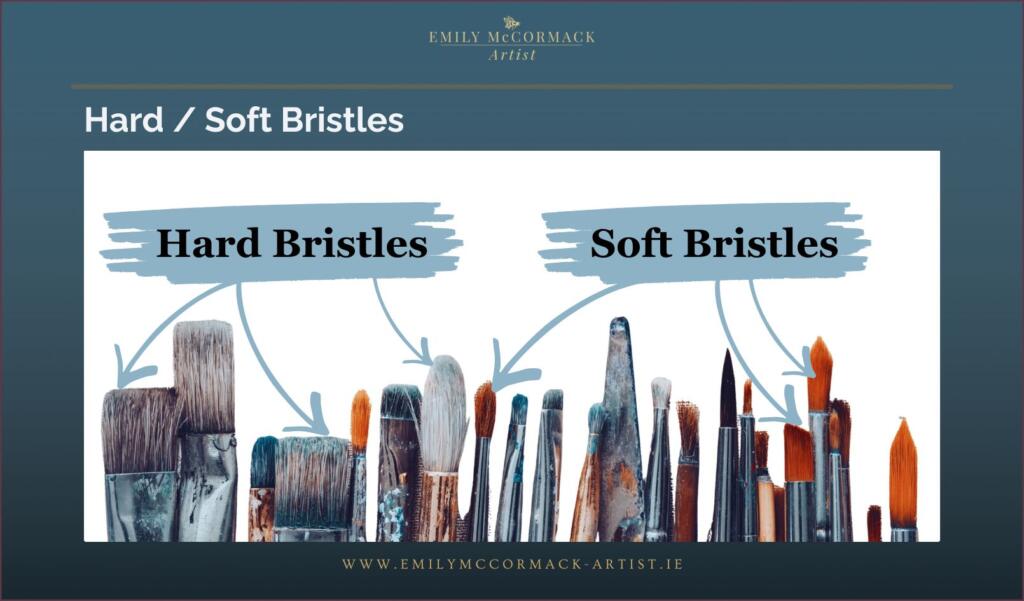
A lot of students get confused about whether to buy hard or soft bristle brushes. The natural instinct is to choose the soft bristle brush first. However, unlike watercolour or acrylics, oil paint is naturally heavy and dense, so the stiffness of the bristles makes a big difference.
In the above diagram, the soft brushes are shown in orange simply as a visual cue, but in reality, soft brushes can be any colour – white, brown, black, golden or mixed fibres. Colour isn’t a reliable indicator of softness; the feel of the bristles is what matters.
Here’s the difference between the two: –
-
Hard bristles
Hard bristles, usually hog or firm synthetics, have the strength to hold the paint and to push thicker paint around the canvas. They’re ideal for creating textured, confident marks and for the early stages of a painting when you’re blocking in shapes and tones.
-
Soft bristles
Soft bristles, whether natural or synthetic, are used mainly for blending, glazing and creating smooth transitions. They glide lightly over the surface, but you’re not really painting with them. They work best when they’re clean and almost dry. Once a soft brush becomes wet or picks up too much paint, it stops blending cleanly, so artists keep several soft brushes on hand and switch to a fresh one as soon as the bristles get loaded.
Over the years in the studio, I’ve noticed that when beginners use soft brushes too early, especially, in the underpainting or when working alla prima (painting all in one go), the painting can go muddy very quickly. This is because soft bristles don’t place paint, they move it. If you use them too soon, they mix all the colours together on the canvas and blur the shapes you’ve already made. Used later in the process, however, they’re great for small touches, softening edges and blending background transitions where the paint is applied in thin layers.
The bristles of the brush can also be natural or synthetic.
-
Natural bristles
Natural‑bristle brushes are traditionally made from the hairs of hog (pig), squirrel or goat, and they’ve been used for centuries because they work extremely well for oils.
Hog bristle is firm and springy, which helps when moving thicker paint, while softer hairs like squirrel or goat hold more fluid paint.
-
Synthetic bristles
Modern synthetic brushes are made from engineered nylon or polyester fibres that are designed to mimic the feel and responsiveness of natural hair.
Manufacturers control the thickness, taper and spring of each filament (the individual synthetic hairs that make up the brush), so synthetics can now behave very much like hog or sable while being consistent, durable, and often more economical and easier to clean.
They perform extremely well in oils and are an excellent option for beginners and experienced painters alike.
A note on sable
You’ll often see “sable” or “Kolinsky sable” in brush catalogues, sometimes even in the oil‑painting section. Despite the name, Kolinsky sable does not come from a true sable. It comes from the tail hair of the Siberian weasel found in Siberia and northern Asia. These hairs form an exceptionally fine point and are traditionally used for watercolour and delicate detail work.
Some brands offer sable brushes for oils, but they’re specialist tools for tiny finishing touches, not something a beginner needs to buy.
An ethical note on bristles and brushes
There’s no perfect eco‑friendly brush, but the most responsible choice is a high‑quality synthetic from a reputable maker. They avoid the animal‑hair supply chain, last for years, and reduce waste far more effectively than cheap synthetics or untraceable natural hair.
Some synthetic ranges also use recycled plastics, which further reduces environmental impact.
Tip before you buy your brushes
Before choosing a brush, lightly run your fingers over the bristles to check the:-
- softness or firmness,
- the spring, and
- whether the hairs form a clean shape.
Even well‑known brands can vary from batch to batch, and occasionally you’ll find brushes where the bristles are stuck together at the tip of the bristles with excess sizing (glue) or don’t spring back well. Feeling the brush in your hand is the best way to judge quality and avoid disappointment.
Brush Handles
Brush handles come in long and short form: –
- Long‑handled brushes (as shown above), are ideal for standing back from the easel, making longer marks, and working with freedom and gesture. This is what I use most often in the studio.
- Short‑handled brushes are favoured by artists who work close to the surface, enjoy fine detail, or paint outdoors (plein air) as they are compact and fit neatly into travel kits.
You may notice “series numbers” on some brush handles. These are internal codes used by each brand to label their different lines. They’re not standardised, so you don’t need to worry about them when starting out.
Brush Size
Brushes typically go from a size 00 (very small) up to a size 24 (very large) and you will usually see the size printed midway along the brush handle as shown in the above diagram and the: –
- higher the number = wider brush, bristles and ferrule.
- lower the number = finer, narrower brush, bristles and ferrule.
Brush sizes aren’t standardised across brands, so a size 10 in one make may be slightly wider or narrower than a size 10 in another. You also don’t need every size, a small, medium and large brush is enough to start. A simple rule of thumb is the larger the canvas or board, the larger the brush you should use.
Brush Brand
There are many brands of oil painting brushes available on the market.
In the studio, we often use Richard Oliver brushes. They’re affordable, an Irish brand, and easily available from K&M Evans in Dublin. They’re perfectly suitable for beginners, and I use them myself because I go through brushes quickly, especially, when working on boards and other textured surfaces.
Other reliable brands you’ll see in most Irish art shops include Winsor & Newton and Raphaël (both offer strong synthetic ranges), as well as Daler Rowney.
For more eco‑friendly or higher‑quality options, look at: –
- Da Vinci (available from Universal Art Supplies, Dublin),
- Escoda,
- Princeton (available from Cork Art Supplies, Cork),
- Pro Arte,
- Tintoretto,
- Borciani e Bonazzi, and
- Rosemary & Co (available from their own website).
If you’d like to explore the full range of shapes and fibres, browsing supplier catalogues or websites, such as Cork Art Supplies, Universal Art Supplies, K&M Evans, or Jackson’s Art Supplies, is a great way to see what each brand offers without needing to buy anything straight away.
Brushes – Starting Off
For beginners in the studio, I recommend starting with just three brushes:
- Size 1 or 2 Round
- Size 4 or 5 Filbert
- Size 10 or 12 Flat
I suggest two size options as very often art supply shops are often out of stock, and you may only find one or the other. With these three types of brushes, you can paint almost anything, and a limited set will help you learn very quickly how each brush behaves without feeling overwhelmed.
If finances are tight, you can begin with just a single filbert and use kitchen roll in place of a larger brush for blocking‑in and softening edges. A small, simple kit is more than enough to get started.
Caring for Your Brushes (Just the Basics)
A full guide is coming soon. For now, here are the essentials: –
- Wipe excess paint before cleaning
- Use solvent sparingly
- Wash with gentle soap
- Reshape the bristles
- Dry flat or bristles‑up
Tip for plein‑air painters or transporting your brushes from your art class:
If you paint outdoors or carry your brushes to and from your art class, you can protect them by storing them in a small wrap‑around brush case. A simple bamboo roll or even a bamboo placemat works well, it keeps the bristles safe, allows them to dry properly, and fits easily into a backpack.
When Your Brush Reaches the End of Its Painting Life
When a brush is no longer suitable for painting, the most ethical option is to repurpose it for priming, varnish, glue, gesso, or general studio tasks. Synthetic brushes can’t be recycled, so extending their use is the best approach. Natural bristles can be composted if removed from the ferrule, but this is optional, the key is simply to get as much use from each brush as possible. In the past, I’ve even been asked to supply old brushes for Junk Kouture projects, which shows the many creative uses a worn‑out brush can still have.
Conclusion: Your Next Steps in Oil Painting
If you’d like to learn how to use these brushes properly including how to hold them, how to work with the tip, the flat, and the side/blade of the brush, I teach all of this in the studio. These skills are much easier to learn in person, where you can see the movements clearly and get immediate feedback.
You can explore:
- The Saturday Beginner’s Oil Painting Workshop (ideal for beginners)
- Our studio-based art classes and/or 1-2-1 workshops
- My free downloadable Materials List for beginners (if you want to build your kit gradually)
- Other free beginner‑friendly blog guides on the site.
Painting is a physical skill, and the way you hold and move the brush makes a huge difference. If you’d like to develop good habits from the start, and learn in a calm, supportive environment, you’re very welcome to join a session in the studio.
A full Oil Painting Manual is currently in development, it’s a project that I’m taking my time with, so it becomes a genuinely useful resource. It will include visual examples of brush marks, layering methods, and practical exercises. If you’d like to be notified when it’s released and to receive new guides and occasional studio updates, you’re very welcome to join our studio mailing list.
Emily McCormack
* As always, I am not affiliated with any brands, stores, or persons I may or may not mention and your use of any of these products, links and the like are your own risk and it’s up to you to do your research/homework before you use them. This is just my opinion and experience.
Become an insider, subscribe to receive our studio newsletter
Our monthly newsletter gives early access to new artwork, studio notes, and first booking for workshops.