
Revised & Updated for 2026
Introduction – 5 Key Steps for Selecting Oil Paints
Choosing oil paints can feel like stepping into a new language; rows of colours, unfamiliar labels, different brands, and a wide range of prices. Whether you’re just beginning or returning to painting after a break, a simple, grounded approach makes the whole process far more enjoyable. These five steps will help you build a colour palette that’s versatile, economical, and a pleasure to work with.
Step One – Choosing Your Colour Palette For Oil Painting
There are countless ways to build a colour palette, and as you progress on your painting journey, you’ll naturally develop a set of go‑to colours that suit your style.
In the studio, we begin with a simple black‑and‑white palette of Titanium White and Ivory Black (also known as an achromatic palette). This helps students get used to the feel of oil paint while only managing two colours, and allows a gentle introduction to value, contrast, and form before bringing colour (hue) into the process.
From there, we move to a foundational colour palette (as shown in the table below) of;
- 2 YELLOWS: Cadmium Lemon Yellow or Pale and Cadmium Yellow Deep,
- 2 REDS: Cadmium Red Deep and Permanent Alizarin Crimson,
- 1 BLUE: Phthalo Blue and
- 1 GREEN: Sap Green.
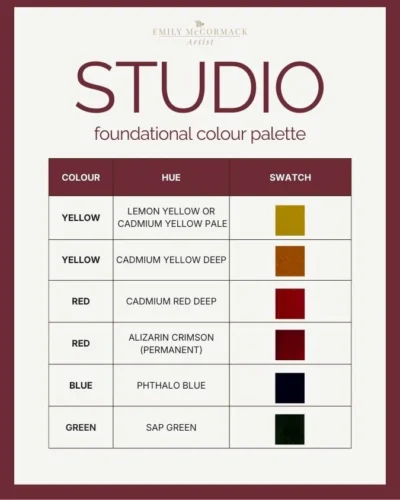
Working with this limited set of five colours allows students to understand how each pigment behaves, mixes, and interacts.
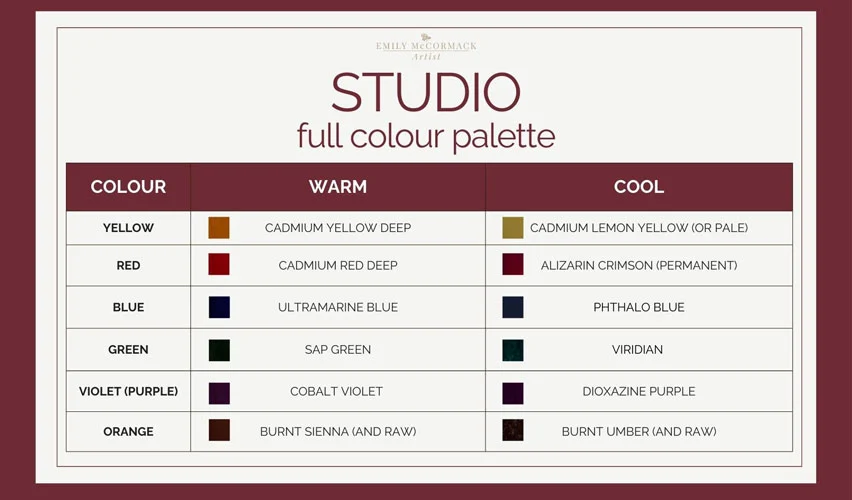
As confidence grows, we expand the palette to include two violets/purples (Cobalt Violet and Dioxazine Purple), and the earth colours, Raw and Burnt Sienna, and Raw and Burnt Umber. You’ll find the full studio colour palette laid out below, organised into warm and cool versions of each colour (hue).
A little note on warm and cool colours
Warm colours lean towards yellow, orange, or red; cool colours lean towards blue or green. Understanding this temperature shift helps you predict how colours will mix and how they will sit together in a painting. This is why we’ve also included Viridian as a cool green and Ultramarine Blue as a warm blue, they complete the temperature relationships within the palette.
You don’t need to worry too much about colour temperature at the beginning, this simply helps to explain how the colour palette is organised, and it becomes more useful as you learn more about mixing colour and developing your painting skills.
So, don’t get bogged down on this; just remember to enjoy the process of painting!
Optional Colours to Add as You Develop
Other optional colours you may like to add as you develop your painting skills include:
- Earth and natural tones: Yellow Ochre, Naples Yellow, Transparent Earth Red
- Additional reds/violets: Cadmium Red, Quinacridone Violet
- Alternative greens: Emerald Green
- Expanded blues: Cerulean Blue, Cobalt Blue, Prussian Blue, Cobalt Turquoise
- Oranges: Cadmium Orange, Transparent Orange
Step Two – Selecting Your Brand of Oil Paint
There are generally two grades of oil paint: student quality and artist (professional) quality.
Artist Quality Paints
Artist quality paints contain a higher concentration of pure pigment, fewer fillers and better lightfastness. This gives them stronger colour, better coverage, and more predictable mixing behaviour. If the front of a tube states “Artist” or “Professional,” you can be confident of its grade. If it doesn’t, it is almost always student quality.
Student Quality Paints
These contain lower concentrations of pigment and more fillers, and their colour mixes can be a little duller than with Artist quality paint.
In the studio, we begin with the student‑quality range from Winsor & Newton, called Winton. It’s an economical option for most beginners, with prices generally sitting at the lower end of the market (though they can vary between retailers and with inflation). One of the reasons we use Winton is that the colours are stable and predictable; they don’t carry strong undertones or unexpected shifts towards green or orange. This makes colour mixing much easier for beginners and helps avoid the muddiness that can happen when working with paints that have hidden biases.
While we begin with student quality paint for practical reasons, we use only stable, reputable ranges. Very low‑grade paints can hinder colour mixing and technique development, so they aren’t suitable for the studio environment.
If you find a student tube priced unusually high, check the label, it may be the water‑mixable version or the Griffin Alkyd range.
Water‑mixable oils use water instead of solvent, and Griffin is a fast‑drying alkyd‑based oil paint. I tend not to use Griffin as some brands can be quite strong in smell and the paint is runnier in texture. That said, it can be useful when you need a painting to dry quickly, as the alkyds speed up the drying time.
A Quick Note on Water‑Mixable Oils
Because they are water‑based, you cannot mix them with traditional oil paints. They must be used together and with water, rather than with solvent or oil mediums.
Artist‑Quality Brands to Explore
As students progress through the workshop levels, we gradually introduce artist-quality paints to replace the student-grade tubes as they are used up. Some of the brands I use include:
- Winsor & Newton,
- Old Holland,
- Michael Harding,
- Rembrandt,
- Sennelier, and
- Gamblin.
Others you may come across include Van Gogh, Vasari, Holbein, and Williamsburg. I use a combination of them all, as each brand has its own strengths, we’ll explore these in more depth in future posts.
Step Three – Reading a Tube of Oil Paint
If you haven’t attended one of my Oil Painting Workshops over the last few years, here’s a simple guide to understanding the information printed on a tube of oil paint.
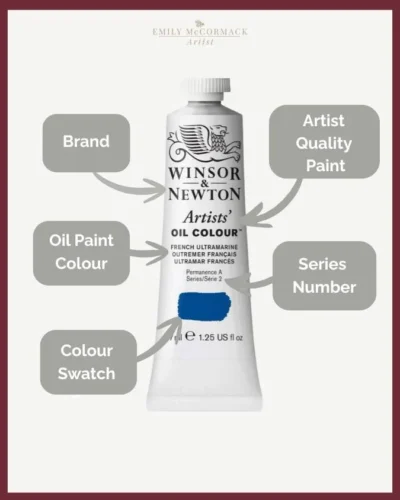
While most of the diagram is self‑explanatory, the series number deserves a little more attention. We’ll look at permanence ratings in a separate post.
Series Numbers
On Winton tubes (Winsor & Newton’s student‑quality range), the Series Number is almost always Series 1, which is the lowest price point in their range.
Their artist‑quality range goes up to Series 5, which at the time of writing can be around €48 for a 37ml tube. Old Holland, by comparison, goes as high as Series 6 or F, and can be significantly more expensive.
As a rough guide:
- Cobalts and cadmiums are usually Series 4 or higher,
- Higher series numbers generally mean more expensive pigments.
A Note on Transparency and Opacity
On the back of the Winton tubes and Winsor & Newton Artist tubes, you’ll usually find a one of the following symbols indicating whether the paint is: –
- opaque,
- transparent,
- semi‑opaque, or
- semi‑transparent.
Other brands often prefer to print these words directly onto the tubes.
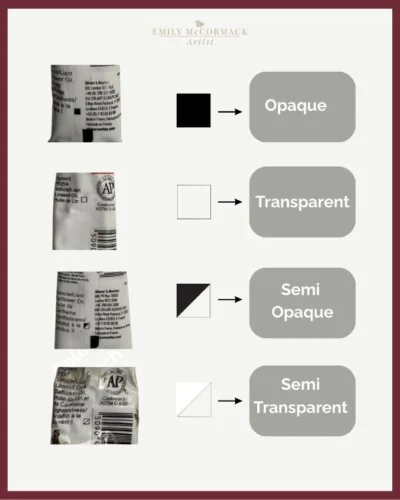
As your painting skills develop, this becomes increasingly important because it relates to the optical qualities of the paint, in other words, whether you can see through it, and whether it’s suitable for glazing.
Examples include:
- Transparent colours: Alizarin Crimson, Raw Sienna, Ultramarine Blue,
- Opaque colours: Cadmium Yellow, Burnt Umber, Cobalt Blue, Titanium White
Understanding these characteristics helps you make intentional choices in your painting, but for now, it’s simply useful to know that not all pigments behave the same way.
Step Four – Should You Buy Large or Small Tubes of Oil Paint?
If you’re just starting out, I strongly recommend buying small tubes of oil paint (37–40ml, or 60ml if you’re using Michael Harding, as that’s their smallest size). The only colours worth buying in large tubes (200ml) at the beginning are Titanium White and Ivory Black.
There’s a very practical reason for this; when you’re learning, it’s easy to squeeze out more paint than you need and end up with large mixes that get contaminated or turn muddy. It happens to everyone in the beginning, and it can feel disheartening, not to mention a little wasteful. Smaller tubes help you avoid that while you’re finding your rhythm.
Smaller tubes help you:
- stay economical,
- avoid over‑mixing,
- learn how much paint you actually need,
- keep your palette clean and intentional.
However, if you’re working at home, have a large palette, or you’ve been painting for a while and can judge your paint usage, then larger tubes make perfect sense. They’re better value in the long run and far more practical once you know your own working habits.
Step Five – Limited or Expanded Oil Painting Palette
For those of you who are more advanced in your painting and colour mixing, I’ve increasingly been working with a very limited palette, currently of:
- Titanium White, Prussian Blue, Cerulean Blue, Cadmium Red (or Bright Red), Transparent Red Oxide or Burnt Sienna, and Lemon Yellow.
If you prefer a slightly expanded version, you could also add:
- Yellow Ochre,
- Alizarin Crimson, and
- Ivory Black.
Using a limited palette has helped me discover beautiful greys, greens, and violets, and it has noticeably improved my colour mixing and colour reduction. Limiting your options often sharpens your eye and strengthens your decisions.
Many artists throughout history have worked with limited palettes. Anders Zorn, the Swedish painter of the late 19th century, famously used just four colours: vermilion, ivory black, white, and yellow ochre (some believe he substituted cadmium red for vermilion due to toxicity). With these four colours he could create blues using the black, as well as greens, purples, browns, and a wide range of subtle greys.
Rembrandt’s palette was also relatively restrained, consisting mainly of yellow ochre, burnt sienna, burnt umber, white, black, and a red such as cadmium red deep.
Of course, once you move into a more expanded palette, you might include a wider range of reds, yellows, greens, blues, and oranges. Typical reds I use include alizarin crimson, cadmium red light, cadmium red deep, perylene red, brown‑pink, and radiant pink. For blues, I might include cobalt blue, ultramarine blue, indigo or manganese blue.
Further Learning
If this topic has sparked your curiosity, you will find more guides on materials, colour mixing, and studio practice in our earlier blogs 2 to 8, which deal with your painting kit, and the colour and colour mixing sections of the blog.
You can also download the free Materials List PDF if you’d like a simple, beginner‑friendly overview of the essentials.
And if you’d like to receive new guides and occasional studio updates, you’re very welcome to join the studio mailing list.

Emily McCormack
* As always, I am not affiliated with any brands, stores, or persons I may or may not mention and your use of any of these products, links and the like are your own risk and it’s up to you to do your research/homework before you use them. This is just my opinion and experience.
Become an insider, subscribe to receive
Our regular monthly newsletter, including stunning previews of new art, discounts, painting tips, new blogs and early booking for painting classes.