
Introduction
Welcome to this month’s Oil Painting Blog for Beginners,* our 40th blog to date.
Initially, I began this blog back in May 2024 to coincide with the National Gallery of Ireland’s exhibition Women Impressionists, which featured the works of four pioneering artists: Berthe Morisot, Mary Cassatt, Marie Bracquemond and Eva Gonzalès. Each of these artists played a vital role in the 19th century Impressionist movement.
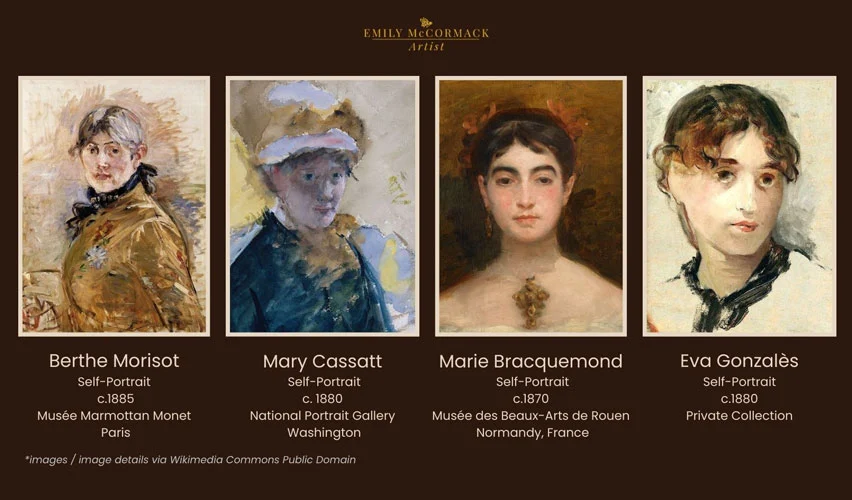
The exhibition ran from 27 June to 06 October 2024 and marked the 150th anniversary of the first Impressionist exhibition held in Paris in 1874. [2] I visited the exhibition on several occasions with various people and each time the experience was very different depending on who I brought.
For me, seeing the paintings in person was a genuine revelation. If I’m honest, until I saw them in the flesh, I wasn’t a real fan of their work, and I didn’t have much interest in their lives or their place in art history. In books, all I ever noticed were the flaky, scratchy marks, the heightened emerald greens and cobalt blues, and the fact that it was women painting women. I had no real sense of the sheer scale of their canvases, their control and understanding of the colour palette, their use of white, or their remarkable mark-making and brushwork.
As I researched for this blog, I began to understand their lives more clearly, their daily struggles working as independent professional artists within the male-dominated world of the 19th century, and the enormous legacy they left behind. Today, their artwork offers us an intimate window into the daily lives and social rituals of the women of that period.
Finally, I started out with plans to include all four women in one blog, but to do them justice, I have divided the blog into three parts. This first part, Part 1 – will look at Impressionism, the role of women within the movement, and our opening artist, Berthe Morisot.
The second part, Part 2 will focus on Mary Cassatt, and the final part, Part 3 on Marie Bracquemond and Eva Gonzalès. My hope is that all three parts will offer you a clearer understanding than I had before I undertook this project, and perhaps open the door to your own discoveries along the way.
Impressionism – When It Started
In 1874, a group of artists, disgruntled by the ultra-conservative selection criteria of the jurors for the Salon Exhibition, held their own independent group exhibition. This group included Claude Monet, Edgar Degas, Pierre-Auguste Renoir, Camille Pissarro, Paul Cézzane, Alfred Sisley and Berthe Morisot. [3]
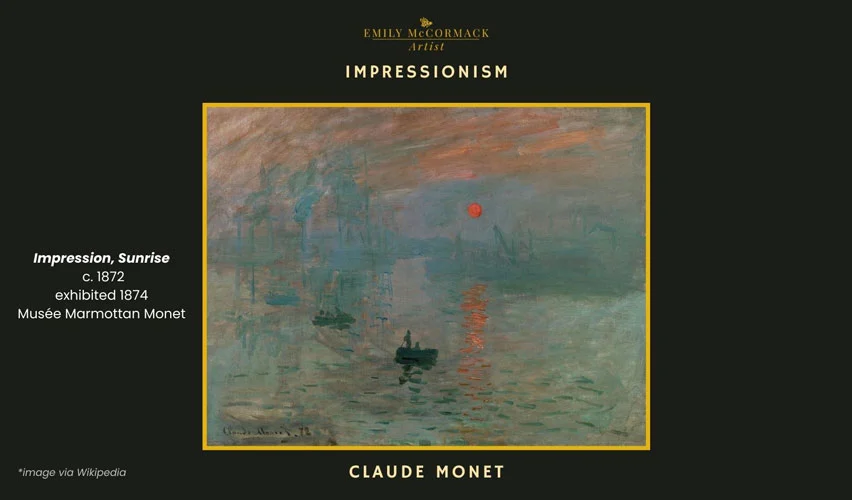
At this exhibition, the art critic Louis Leroy dismissed Claude Monet’s painting Impression, Sunrise as merely a sketch or “impression,” arguing that it was not an actual finished painting by the standards of that time. Monet’s approach, short, broken brushstrokes that barely conveyed forms, pure unblended colours, and an emphasis on the effects of light, [4] was radically different from academic expectations. Leroy’s remark, intended as an insult, ultimately gave the group and new art movement the name Impressionism.
As Impressionism developed, it became the first major art movement in which women played a leading role, both as innovators [5] and active promoters of the movement. The movement’s growing openness allowed artists such as Mary Cassatt, Marie Bracquemond and Eva Gonzalès to become central figures within it.
Impressionism, Revolutionising The Role Of Women Artists
This was a time when women’s roles were predefined for them. Their legal rights and movements were restricted, their access to formal training was limited (women were barred from studying at École des Beaux-Arts until 1897), and their participation in public life was tightly controlled and segregated by class. The artist Marie Bashkirtseff gives us an idea of these controls:
“What I long for is the freedom of going about alone, of coming and going, of sitting in the seats of the Tuileries and especially in the Luxembourg, of stopping and looking at the artistic shops, of entering the churches and museums, of walking about the old streets at night; that’s what I long for; and that’s the freedom without one cannot become a real artist.” [6]
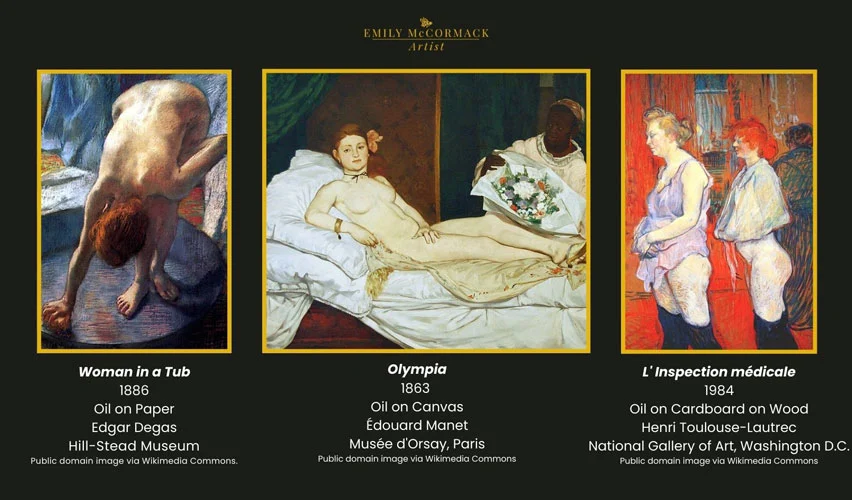
By contrast, their male counterparts were permitted to move freely and unchaperoned through the public world. Men could attend cafés, studios, even brothels (as in the case of Degas and Toulouse-Lautrec); they could paint and exhibit the female nude, enrol in formal art schools, and pursue professional artistic careers without any social consequence.
Within this context, the emergence of Impressionism offered something genuinely radical: a space where women could paint the world they inhabited, claim visibility in a male‑dominated art world, and develop a professional identity beyond the domestic sphere.
Yet despite these new possibilities, women were still conditioned to know “their place” and to avoid upsetting the men in their lives. What may seem humorous now posed real dilemmas at the time, as seen in the case of one of our female artists, Berthe Morisot. By 1870, she was already exhibiting at the Salon, but when preparing a painting for submission that year, she allowed Édouard Manet another Impressionist painter, to critique it, a decision she quickly regretted.
In a letter to her sister Edma, she described how Manet enthusiastically took over the canvas:
“He found it very good, except for the lower part of the dress. He took the brushes and put in a few accents that looked very well; mother was in ecstasies. That is where my misfortunes began. Once started, nothing could stop him; from the skirt he went to the bust, from the bust to the head, from the head to the background. He cracked a thousand jokes, laughed like a madman, handed me the palette, took it back; finally by five o clock in the afternoon we had made the prettiest caricature that was ever seen. The carter was waiting to take it away [to the Salon admissions jury]; he made me put it into the hand-cart, willy-nilly. And now I am left confounded. My only hope is that I shall be rejected. My mother thinks this episode is funny, but I find it agonising.”
Her mother, trying to help, requested the return of the painting, agreeing that Manet had made a “pretty mess” of it and that his alterations to the head were “atrocious.” Yet, not wanting to offend Manet, they ultimately resubmitted the work. [7] She also noted in her notebook diary of 1890:
“I don’t think there has ever been a man who treated a woman as an equal, and that’s all I would have asked for – I know I am worth as much as they are.” [8]
These examples offer a small glimpse into the indignities women artists were expected to endure, while at the same time having to maintain composure and good manners even when their professional work was being undermined.
Impressionism – The Four Women Who Shaped The Movement
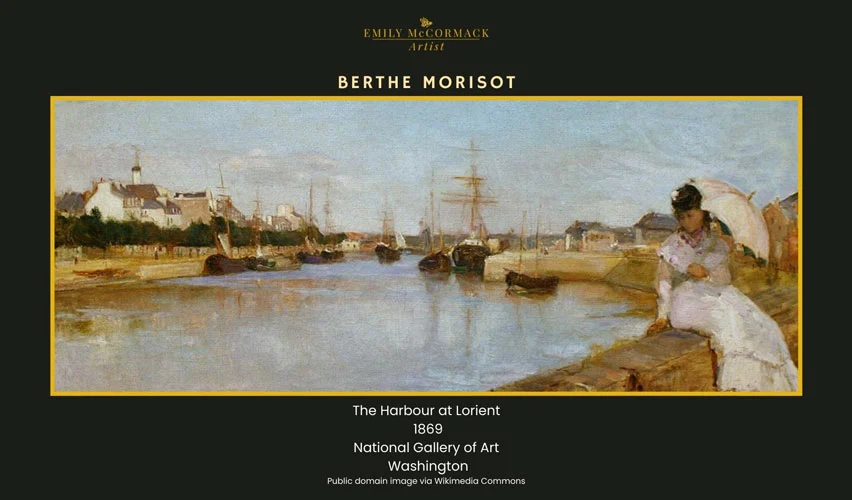
Berthe Morisot (1841 – 1895)
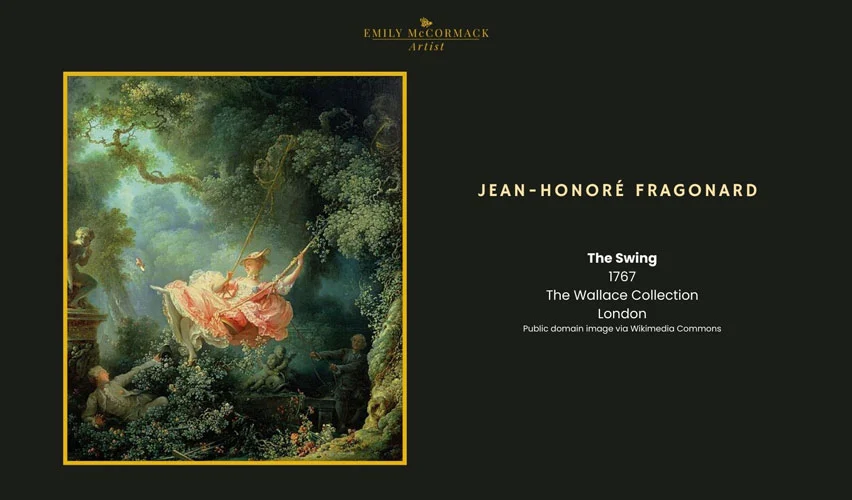
Berthe Morisot, according to legend, is said to be a direct descendant of Jean-Honouré Fragonard (1732-1806), a leading 18th century [9] Rococo artist best known for his painting ‘The Swing’.
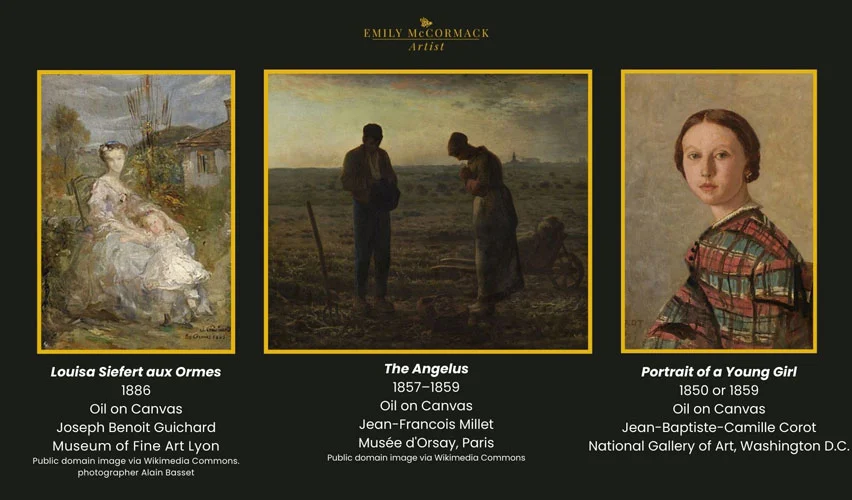
Initially, encouraged by her mother to paint, and as previously mentioned, because schools such as the Ecole des Beaux-Arts were closed to women until 1897 [10], she was privately taught by some of the leading artists of that time, including Guichard (a former pupil of Ingres [11], Millet and the radical landscape artist Corot.
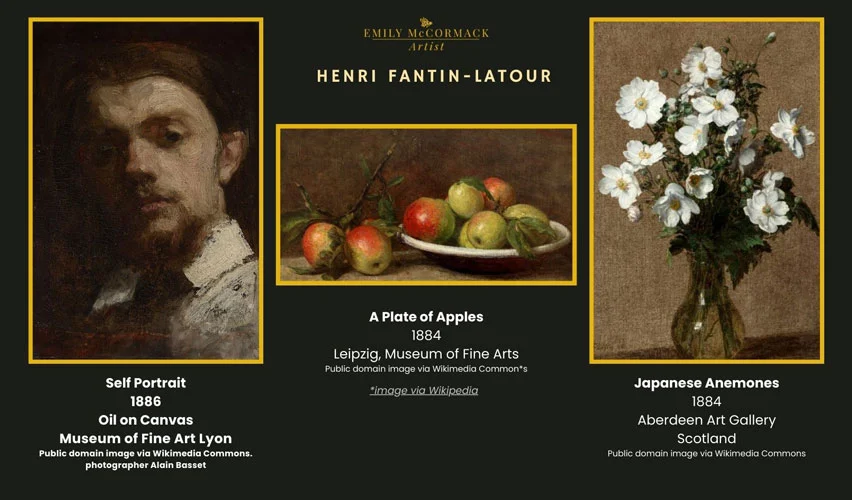
In 1858, at the age of seventeen, she was granted permission to copy Old Master drawings at the Louvre, and it was there that she became acquainted with the self-taught artists Marie Bracquemond and Henri Fatin-Latour (1936 – 1904). [12]
Her debut at the Salon occurred in 1864, [13] at the age of twenty-four. It is said that, apart from about two dozen works, she apparently, destroyed all her early work prior to turning thirty. [14] In addition many may have been lost/destroyed during the Franco-Prussian War of 1870.
In 1872, after an introduction to the art dealer Paul Durand‑Ruel, she began selling her work, the sale included Harbour Scene (1871) [15] and several watercolours, thus establishing herself within the emerging market for modern art. She was the only woman to exhibit in the very first Impressionist exhibition of 1874 and went on to participate in seven of the eight group exhibitions, more than many of her male peers, placing her at the heart of the movement.
In the same year, she married Eugène Manet, Édouard Manet’s younger brother, who was throughout their marriage extremely supportive of her career as an artist and even posed for her on three occasions, despite not relishing the task.
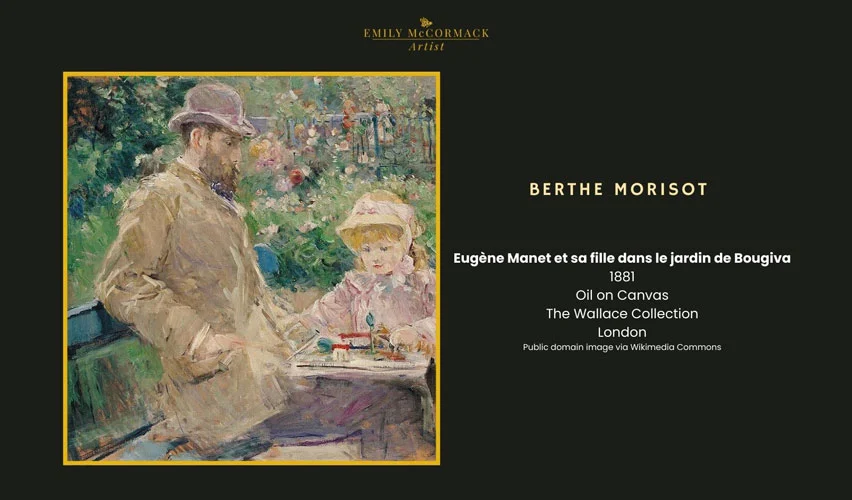
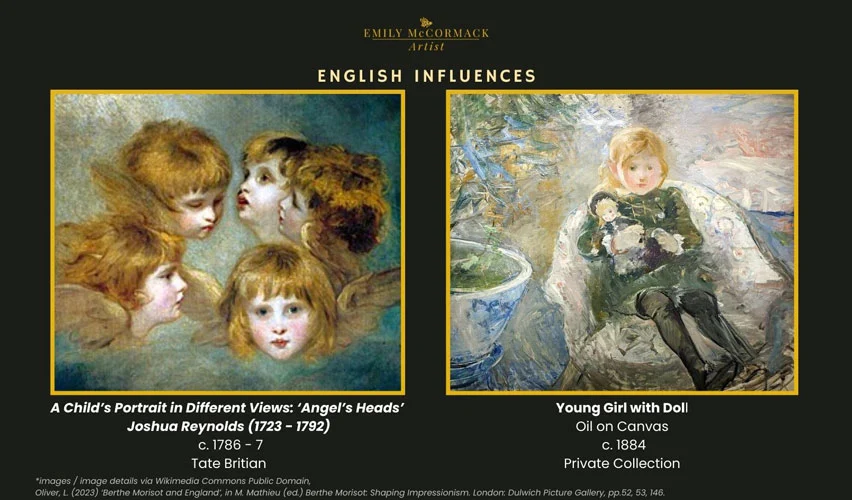
During their honeymoon in England, including London and the Isle of White, he encouraged her to paint, network with English high society and to visit the galleries and grand houses. This is where she got to view works by English artists such as Gainsborough, Reynolds and Romney who would later influence her own work. [16]
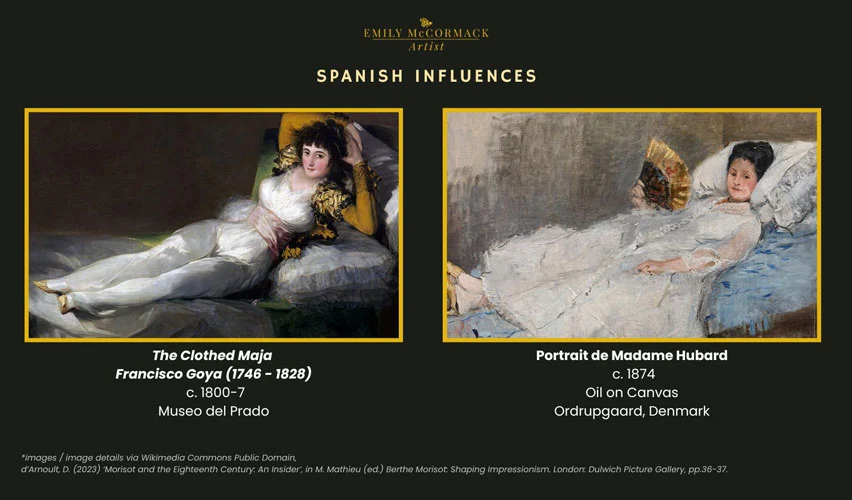
She was also influenced by the Spanish artist Goya, [17] whose work she saw in the Prado Museum in Madrid.
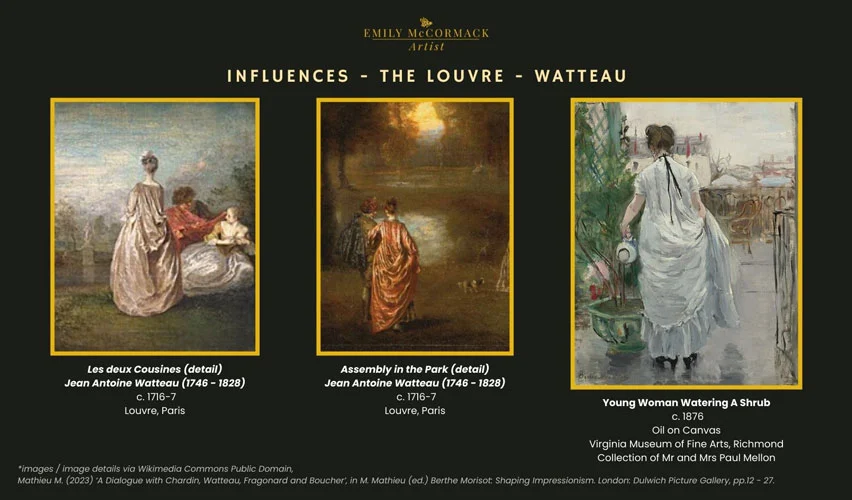
Along with 18th Century French artists, such as Chardin, Fragonard, Boucher and Watteau [18] whom she saw and studied in the Louvre, Paris.
She worked in oil, watercolour, pastel and gouache, choosing the medium that best suited the immediacy or intimacy of her subject. Her work is often characterised by luminous, fluid brushwork and a palette of soft greys, greens, and rose tones.
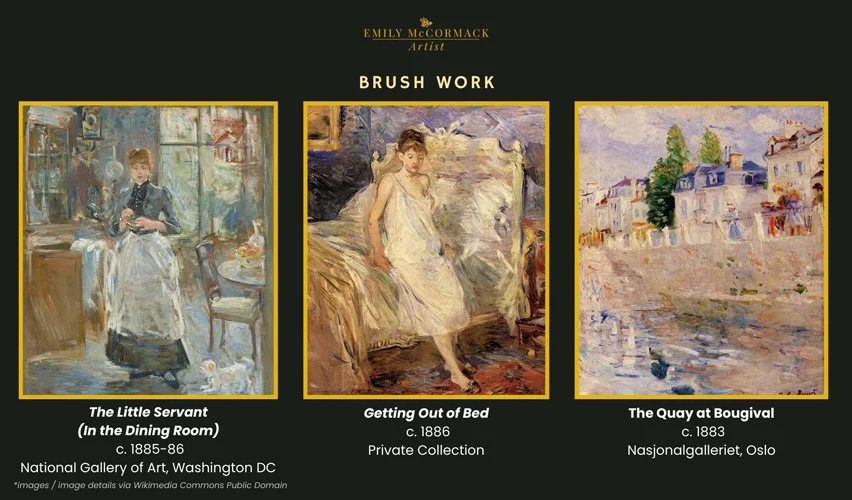
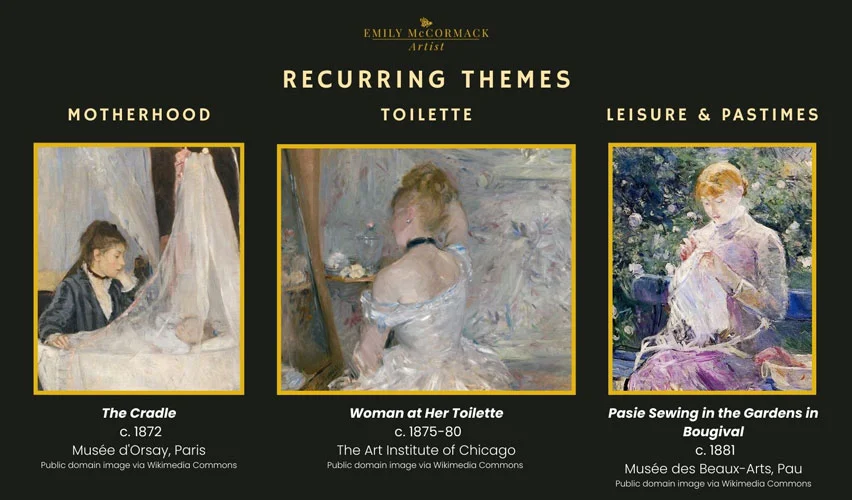
She painted the world immediately around her: domestic interiors, women at work, gardens, the sea and recurring themes such as motherhood, the toilette, and women’s pastimes.
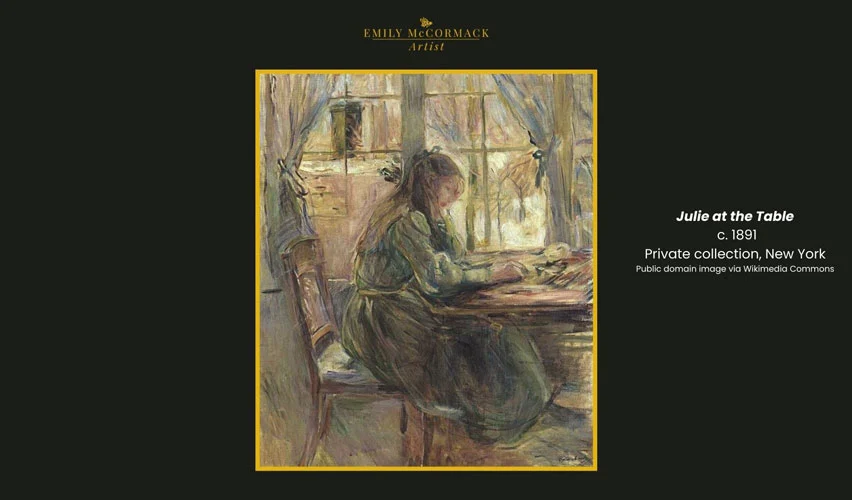
In later life, her daughter Julie became a frequent subject to paint.
On 02 March 1895, while caring for Julie, who was suffering from symptoms resembling pneumonia, Morisot contracted the illness herself. She died shortly afterwards at the age of fifty-four, leaving sixteen‑year‑old Julie an orphan; Eugène had passed away three years earlier.
The day before her death, she wrote a final letter to her daughter:
“My little Julie, I love you as I die; I shall still love you when I am dead; I beg you not to cry, this parting was inevitable. I hoped to live until you were married…. Work and be good as you have always been; you have not caused me one sorrow in your little life. You have beauty, money; make good use of them…. Please give a remembrance to your Aunt Edma and to your cousins…” [19]
The following year, Monet, Renoir, Degas, and the poet Mallarmé organised a major posthumous retrospective at the Durand‑Ruel galleries, featuring more than 400 paintings, pastels, watercolours, and sculptures by Morisot. [20] As Stuckey and Scott [21] observed:
“No exhibition in the history of art has ever had a more distinguished installation committee.”
After her mother’s death, Julie took on the role of custodian of Morisot’s work. She organised exhibitions, protected the family archive, and ensured that her mother’s contribution to Impressionism was recognised long after her own lifetime.
Today, Morisot is recognised as one of the most innovative painters of the Impressionist movement, an artist whose work reshaped the visual language of modern domestic life and managed to expand the possibilities available to women in the arts at that time.
THAT’S IT FOLKS FOR THIS MONTH……
Until next month, when we will continue our oil painting journey and look at the life and works of Mary Cassett.
Emily
January 2026
* As always, I am not affiliated with any brands, stores, or persons I may or may not mention and your use of any of these products, links and the like are your own risk and it’s up to you to do your research/homework before you use them. This is just my opinion and experience.
[1] Banner image: Detail from “Berthe Morisot with a Muff” (1871–72) by Édouard Manet. Bequest of Leonard C. Hanna Jr., Cleveland Museum of Art. Public domain image via Cleveland Museum of Art Open Access.Banner image: Detail from “Berthe Morisot with a Muff” (1871–72) by Édouard Manet. Bequest of Leonard C. Hanna Jr., Cleveland Museum of Art. Public domain image via Cleveland Museum of Art Open AccessBanner image: Detail from “Berthe Morisot with a Muff” (1871–72) by Édouard Manet. Bequest of Leonard C. Hanna Jr., Cleveland Museum of Art. Public domain image via Cleveland Museum of Art Open Access
[2] National Gallery of Ireland, ‘Women Impressionists’ (National Gallery of Ireland Website (2024)) <https://www.nationalgallery.ie/art-and-artists/exhibitions/women-impressionists>accessed 6 November 2025
[3] Sanna, A., Impressionism. Visual Encyclopaedia of Art, (Scala Group S.p.A., 2010)
[4] Samu, M., ‘Impressionism: Art and Modernity’, (New York : Metropolitan Museum of Art (2004)), <https://www.metmuseum.org/toah/hd/imml/hd_imml.htm#:~:text=The%20New%20Painting%3A%20Impressionism%201874%E2%80%931886 >accessed on 09 January 2025
[5] Lucie-Smith, E., Impressionist Women, (London: Phoenix Illustrated, Orion Publishing Group 1989)), p. 7
[6] Garb, T., Women Impressionists, (1st edn., Phaidon Press, Oxford (1986)), p.9
[7] Stuckey, C.F. & Scott, W.P., Berthe Morisot – Impressionist, (1st edn., Wilson Publishers Limited (1987)), p. 36
[8] Whitmore, J., ‘Exhibition review of Berthe Morisot: Woman Impressionist’, (Nineteenth‑Century Art Worldwide 18, no. 1 (Spring 2019), <https://doi.org/10.29411/ncaw.2019.18.1.13> accessed on 6 January 2026
[9] Shennan, M., Berthe Morisot – The First Lady of Impressionism, (1st edn. Sutton Publishing Limited (1996)) p.xxiv
[10] Stuckey, C.F. & Scott, W.P., Berthe Morisot – Impressionist, (1st edn., Wilson Publishers Limited (1987)), p.17
[11] Kay, A., Berthe Morisot, Masterpieces of Art, (1st Ed, Flame Tree Publishing (2020)), p.6
[12] Stuckey, C.F. & Scott, W.P., Berthe Morisot – Impressionist, (1st edn., Wilson Publishers Limited (1987)), p.19
[13] Ibid, p.20
[14] Ibid, p.16
[15] Ibid, p.50
[16] Oliver, L. ‘Berthe Morisot and England’, in M. Mathieu (ed.) Berthe Morisot: Shaping Impressionism (London: Dulwich Picture Gallery (2023)), pp. 42–58
[17] d’Arnoult, D. ‘Morisot and the Eighteenth Century: An Insider’, in M. Mathieu (ed.) Berthe Morisot: Shaping Impressionism (London: Dulwich Picture Gallery (2023)), pp.36-37
[18] Mathieu M. (2023) ‘A Dialogue with Chardin, Watteau, Fragonard and Boucher’ in M. Mathieu (ed.) Berthe Morisot: Shaping Impressionism (London: Dulwich Picture Gallery (2023)), pp.12 – 27
[19] Wikipedia, ‘Berthe Morisot’, (Wikipedia (2025)) <https://en.wikipedia.org/wiki/Berthe Morisot> accessed 12 January 2026
[20] Stuckey, C.F. & Scott, W.P., Berthe Morisot – Impressionist, (1st edn., Wilson Publishers Limited (1987)), p. 15
[21] Ibid.